
Icebreakers and Team Building Activities for Work
20 icebreakers for work meetings and 24 team exercises from Couchinfo leadership trainings — each with timing, step-by-step instructions and debrief questions. Read them here or download the whole collection as a PDF.
- Icebreakers of 3–12 minutes for regular meetings, new teams and long workshops
- Team exercises of 10–65 minutes on accountability, feedback, coaching and change
- Written by Stan Shaposhnikov, psychiatrist by training, psychotherapist and corporate trainer since 2001
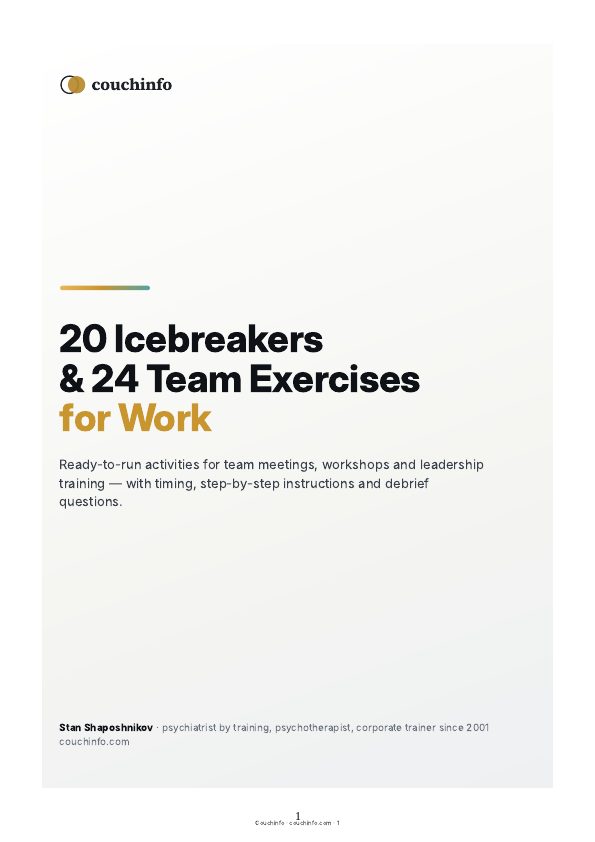
Get the free PDF
20 icebreakers + 24 team exercises, 20 pages. We'll email you the download link.
20 icebreakers for work meetings
Use a check-in at the start of regular meetings, a “getting to know you” icebreaker for new teams, and a movement activity after lunch in long workshops. The PDF adds a facilitator tip to each one.
01. Two-Word Check-In
Everyone describes how they arrive at the meeting in exactly two words. No explanations, no comments from others.
02. Weather Report
Each person names the weather that matches their week: “sunny with clouds by Thursday”, “fog lifting”, “storm warning”.
03. One Win, One Block
Each person shares one thing that went well since the last meeting and one thing that is blocking them right now.
04. Rose, Thorn, Bud
Rose: a success. Thorn: a difficulty. Bud: something new you are looking forward to. One sentence each.
05. Energy 1–10
Everyone names their energy level from 1 to 10 and one thing that would add a single point today.
06. The Tool I'd Keep
If you could keep only one work tool, app or habit, which would it be and why?
07. First Job Lesson
Each person shares one thing they learned in their very first job that they still use.
08. Hidden Skill
Everyone shares a skill colleagues probably don't know they have — at work or outside it.
09. Best Advice at Work
Each person shares the most useful piece of work advice they have ever received and who gave it.
10. Two Truths and a Lie: Work Edition
Each person shares three facts about their working life; the group guesses which one is false.
11. Common Ground
In pairs, find three things you have in common that are not obvious (not “we both work here”). Share the most surprising one.
12. What Success Looks Like
Before the agenda, each person finishes the sentence: “This meeting will be worth it if…”
13. One Word for the Project
Everyone names one word that describes the current state of the project. Then discuss the two most different words.
14. Line-Up
Without talking, the group lines up by years in the profession, then by number of cities lived in.
15. Looking Forward
Each person shares one thing they are looking forward to this month — at work or outside it.
16. Unpopular Opinion (Light)
Each person shares a harmless “unpopular opinion” about work: meetings, email, office coffee.
17. Thank You Round
Each person thanks one colleague for something specific from the past week.
18. Story Behind a Photo
Volunteers show the most recent photo on their phone they are happy to share and tell the story behind it.
19. If I Had an Extra Hour
Each person says what they would do with one extra hour in their work week.
20. Question Jar
Put work-safe questions on cards (“What made you choose this profession?”, “What's a small thing that makes your day better?”). People pick one and answer.
24 team building exercises for work
Each exercise trains a real management skill and ends with a debrief that links it to work. Click an exercise for the full instructions, or get all 24 in the PDF.
Excuse → Step
Master the formula of the language of accountability: fact — my part — what I will do — by when.
Leadership and AccountabilityGame "Opening a New Branch"
Experience how responsibility is shared in a group when nobody has been put in charge, and see your own habitual roles.
Leadership and AccountabilityRACI: The Industry Trade Show
Build a RACI matrix on a training case and check it against the rules.
Coaching and Team LeadershipInstruction or Question
Learn to turn habitual management instructions into open questions that get the employee thinking.
Coaching and Team LeadershipGROW in Threes
Hold a short development conversation using the GROW model on a real work issue and get feedback.
Coaching and Team LeadershipFeedback on Cases
Practice corrective and supportive feedback using a five-step structure.
Performance Management with AIHow to Game a KPI
See the loopholes in metrics and learn to close them with a balanced set.
Performance Management with AIThe One-to-One
Practice a regular one-to-one in six steps and find out something the manager did not know.
Performance Management with AISpot the AI's Mistakes
Learn to check an AI assistant's answer with a short checklist.
Emotional Intelligence for LeadersDebate Game "Zigzag"
Experience the emotions of an argument in a safe game and learn to analyze your reaction: what set off the emotion and how it affected your words.
Emotional Intelligence for LeadersRewrite the Email
See how the tone of a message affects the recipient's emotions, and learn to rewrite sharp messages without losing the substance.
Emotional Intelligence for LeadersProvocation Cards
Practice a calm response to provocation in a safe form: the phrases come from a role, not from a colleague.
AI and Automation Adoption: Leading Your Team Through ChangeVoices of the Curve
Learn to recognize the stage of the change curve from an employee's words and choose the manager's response.
AI and Automation Adoption: Leading Your Team Through ChangeThe Force Field of My Change
See the forces that drive a change and hold it back, and choose what to weaken first.
AI and Automation Adoption: Leading Your Team Through ChangeA Conversation with Someone Who Resists
Practice a five-step conversation with an employee who is resisting the adoption of AI.
Motivation and Inspiration Tools for LeadersIdentify the Style
Practice recognizing an employee's behavioral style using the DISC model from a description, and naming the signs the conclusion is based on.
Motivation and Inspiration Tools for LeadersThe Leader's Two-Minute Speech
Learn to tell the team briefly about a goal or a change so that it is clear why it is needed and what matters from each person.
Motivation and Inspiration Tools for LeadersCriticism Without Demotivation
Practice six-step criticism with employees of different styles so that the person puts things right instead of getting defensive.
Managing Processes and Resources: Unconventional SolutionsBusiness Game "The Tower"
Give the group a shared experience of working on a task with limited resources, which is then used to debrief goal setting, choice of strategy and roles.
Managing Processes and Resources: Unconventional SolutionsPoints of View
Reformulate a work problem through the eyes of different people and find new directions for solutions.
Managing Processes and Resources: Unconventional SolutionsControl Map
Build control of your own task in advance and without the typical mistakes: total, hidden or "occasional" control.
Managing Your Inner Resources: Energy, Motivation, RecoveryBalls and Stones
See completed and unfinished tasks and move one "stone" — a task that has been hanging around for a long time.
Managing Your Inner Resources: Energy, Motivation, RecoveryCircle of Influence
Sort sources of stress into what depends on me, what I can influence through others and what does not depend on me — and choose an action for each circle.
Managing Your Inner Resources: Energy, Motivation, RecoveryBelief Review
Find your own limiting work beliefs using marker words and see how much energy they take.
Frequently asked questions
What are good icebreakers for work meetings?
Short, low-pressure ones that take 3–8 minutes: a two-word check-in, energy from 1 to 10, one win and one block, or finishing the sentence “this meeting will be worth it if…”. They help people switch into the meeting without asking for personal details.
What is the difference between an icebreaker and a team building exercise?
An icebreaker warms a group up in a few minutes. A team building exercise takes 20–60 minutes and trains a skill — agreeing on responsibilities, giving feedback, making decisions together — and always ends with a debrief that links it to real work.
How long should a team building activity at work take?
For a regular team meeting, 10–30 minutes is enough. In a workshop or training day, exercises of 30–60 minutes work well, as long as about a third of the time goes to the debrief.
Are these activities free to use?
Yes. You can run the icebreakers and exercises from the PDF in your own team or with your own clients. The full two-day training kits with scripts, slides and cards are available separately.
Run a full two-day training — free
The complete Leadership and Accountability kit: facilitator script, slides, workbook, exercises and tests. Other kits from $229.
Read also: Giving feedback to employees · Team building or training · Training employees with no time