
Presentation Skills for Managers training
Managers and specialists learn to prepare a talk for a specific audience and goal, state the main point, make clear slides, handle nerves and answer tough questions — so that listeners make a decision.
Trainer license — one facilitator, who can also run it for their own clients. Company license — all trainers and managers in your company. Details
Card payment via Stripe · files right after payment and by email
A training you can run without the author
2 days, minute by minute
A trainer guide with what to say, exercise instructions, debrief questions and difficult situations.
17 exercises
Role plays, cases and cards — with print-ready handouts.
Tests with answer keys
A pre- and post-test to see what participants have learned.
An author with corporate experience
Stan Shaposhnikov: programs for PrivatBank, DTEK, Interpipe.
Invoice for your company
Leave your company details — we will send an invoice and deliver the files once it is paid.
Who this training is for
- Team and department managers
- Project managers
- Specialists who present to senior management and clients
- Internal trainers and L&D
- Independent trainers
Problems it solves
- Reports to senior management drag on and no decision is made
- Slides are packed with text and the speaker reads them aloud
- Strong specialists freeze in front of an audience
- After a project pitch nobody can repeat the main point
- One tough question from the room derails the whole talk
What participants will be able to do
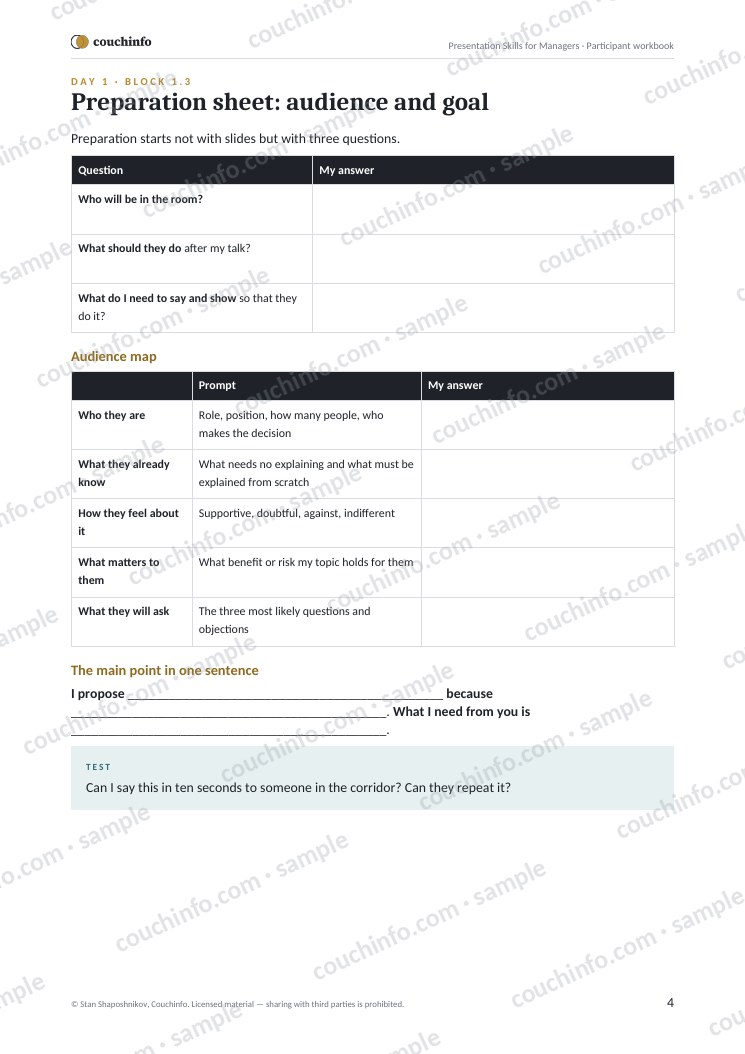
Prepare a talk with a preparation sheet: who is in the room, what matters to them, what they should do after the talk
State the main point in one sentence and build the whole talk around it
Build a structure: opening, body, strong moment, close with a call to action
Open so that people listen from the first minute and close with a specific request
Support the point with a story and with numbers: one number — one conclusion
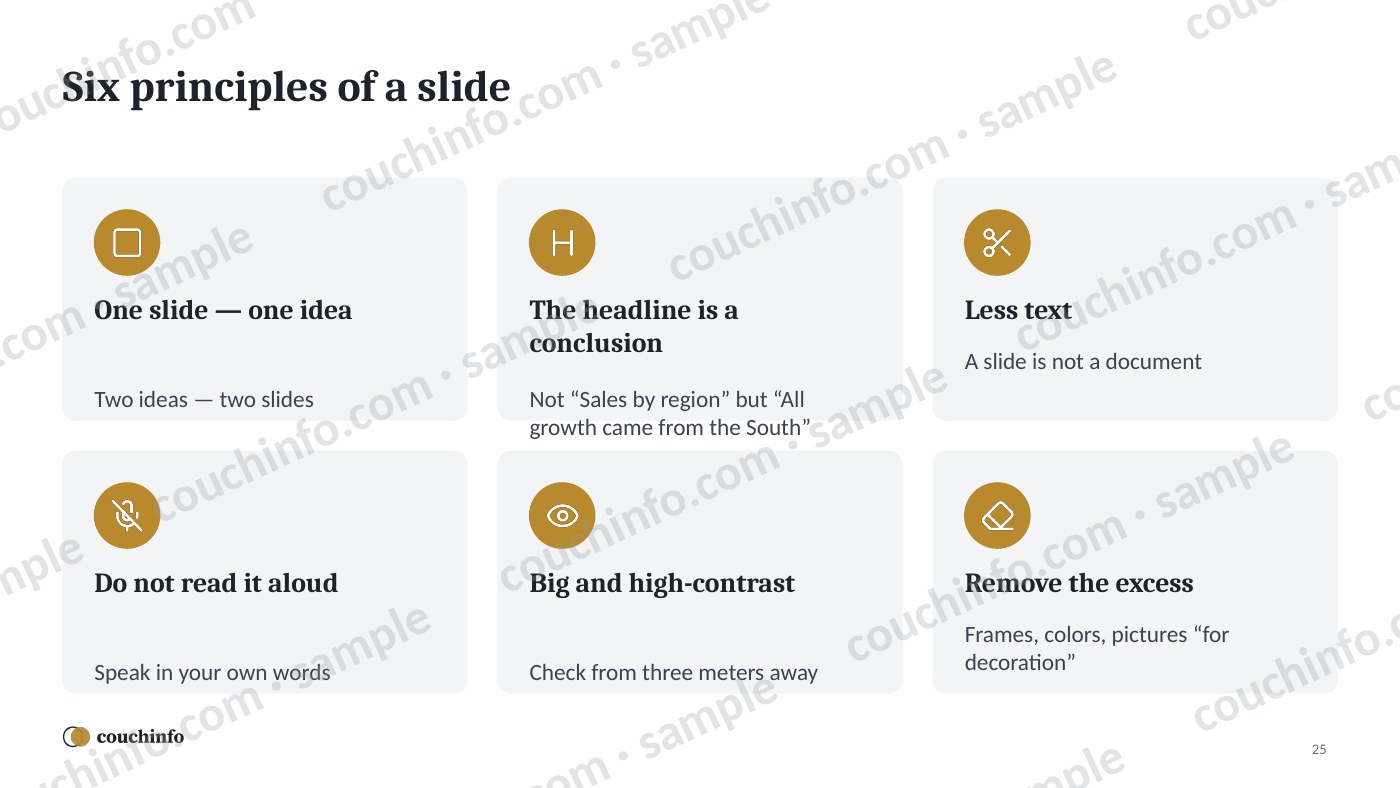
Make slides on the principle "one slide — one idea" with a conclusion headline
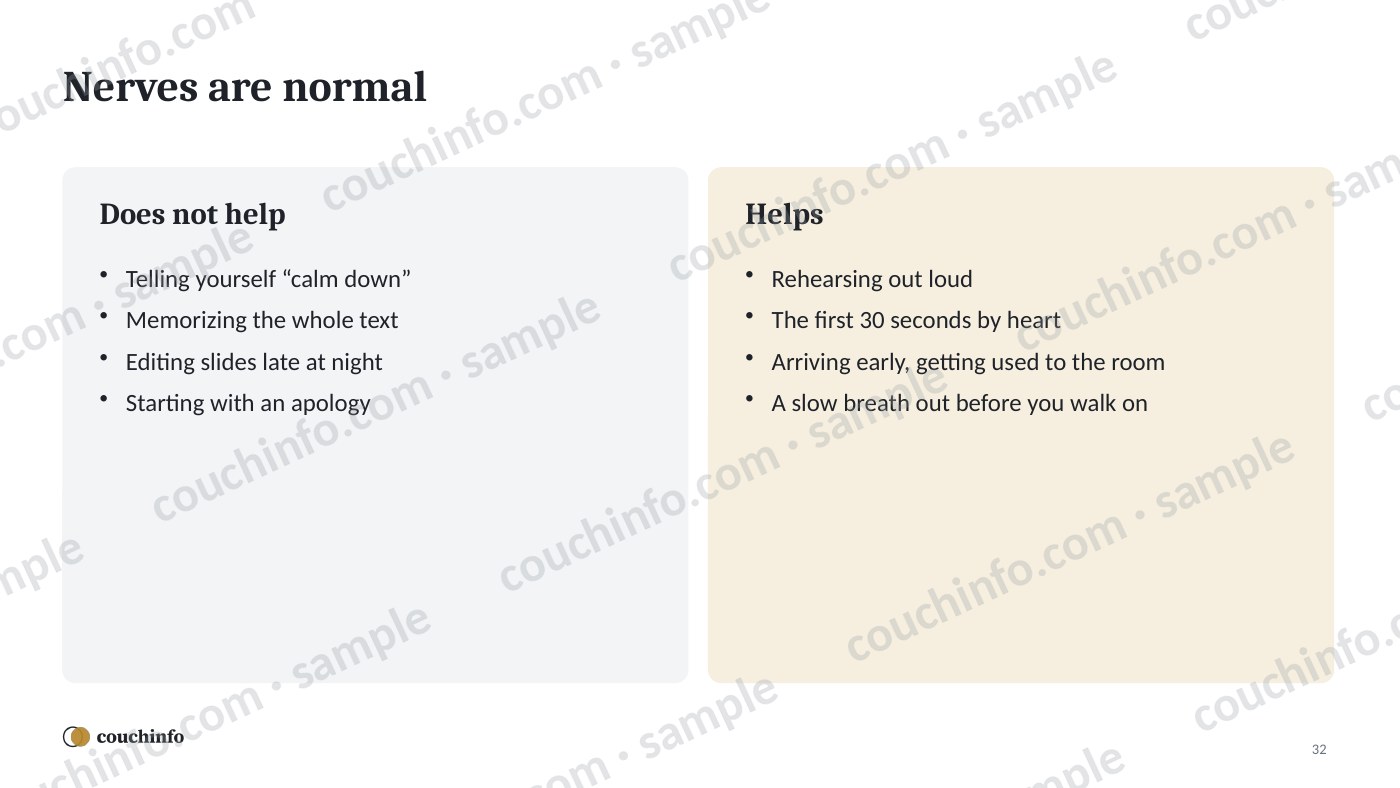
Handle nerves: prepare, rehearse out loud and use the energy of excitement
Keep contact with the audience: eye contact, pause, voice, movement
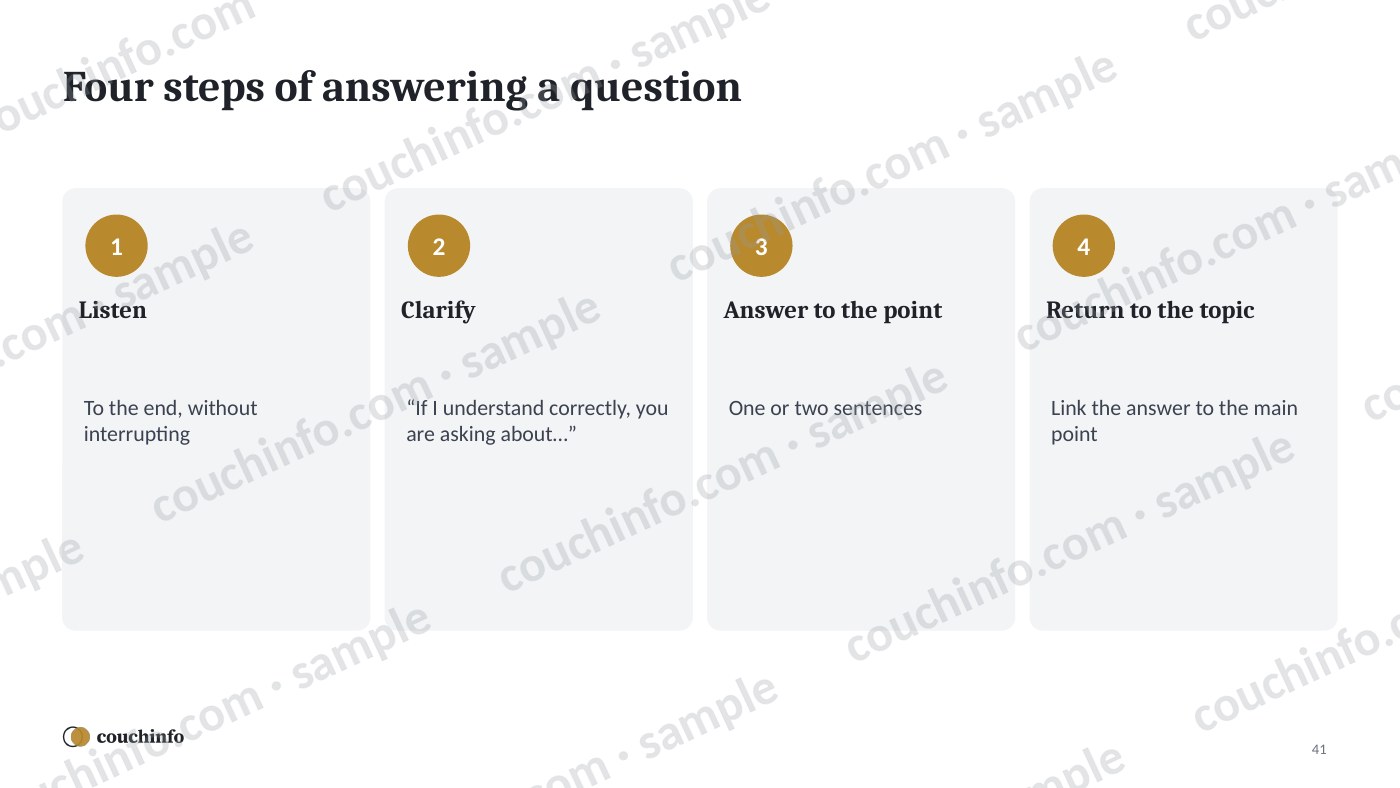
Answer tough questions and stay composed when the equipment fails or the time is cut in half
Present to senior management in five minutes and give talks online
Use AI to prepare and rehearse, checking the facts and without disclosing confidential data
Training program: Presentation Skills for Managers
Two days, 10:00–18:00 · lunch and two breaks each day
| Day 1. Prepare the talk | |
|---|---|
| 10:00–10:40 | Opening, ground rules, introductions "A talk I remember", pre-test |
| 10:40–11:15 | First talk: "One minute as is". What makes a talk strong |
| 11:30–12:30 | Audience and goal: three questions, audience map, the main point in one sentence |
| 13:30–14:30 | Structure of a talk. "Talk skeleton" practice |
| 14:30–15:15 | Opening and close. "The first 30 seconds" practice |
| 15:30–16:35 | Story and data: "situation — complication — resolution", one number — one conclusion |
| 16:35–17:40 | Slides that help. "Fix the slide" practice |
| 17:40–18:00 | Day review, assignment "My 5-minute talk" |
| Day 2. Deliver it and answer questions | |
|---|---|
| 10:00–10:20 | Warm-up: the main point of my talk in 30 seconds |
| 10:20–11:15 | Nerves and state: what helps, rehearsal, pre-talk checklist |
| 11:30–12:30 | Delivery and contact: voice, pause, eye contact, movement. Self-assessment |
| 13:30–14:40 | Audience questions and difficult situations |
| 14:40–15:15 | Presenting to senior management and online |
| 15:30–16:00 | AI as a rehearsal partner. "Slide from AI" practice |
| 16:00–17:35 | Final talks: 5 minutes, questions, feedback |
| 17:35–18:00 | 30-day plan, post-test, feedback form, closing |
What's included: slides, trainer guide, workbook
Slide deck
54 slides with presenter notes (PowerPoint)
Trainer guide
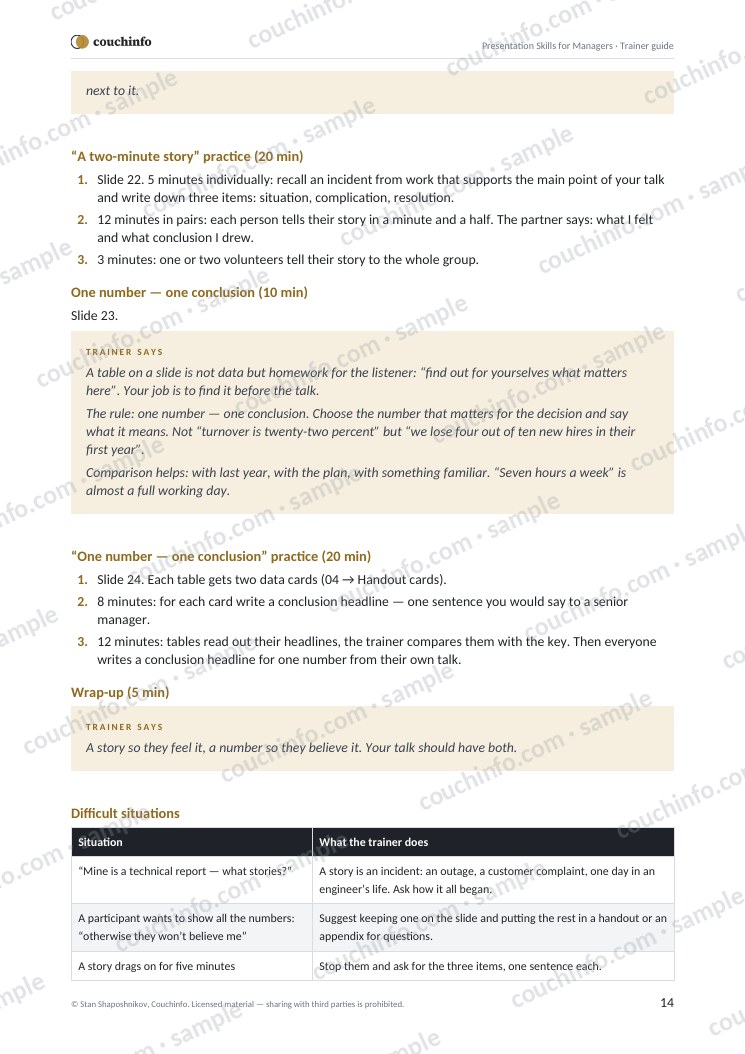
29 pages: a minute-by-minute script for both days with what to say, debriefs and difficult situations
Participant workbook
17 pages: talk preparation sheet, skeleton, opening and close, story and data, slides, pre-talk checklist, the "My speaker profile" self-assessment, 30-day plan
Exercises and cases
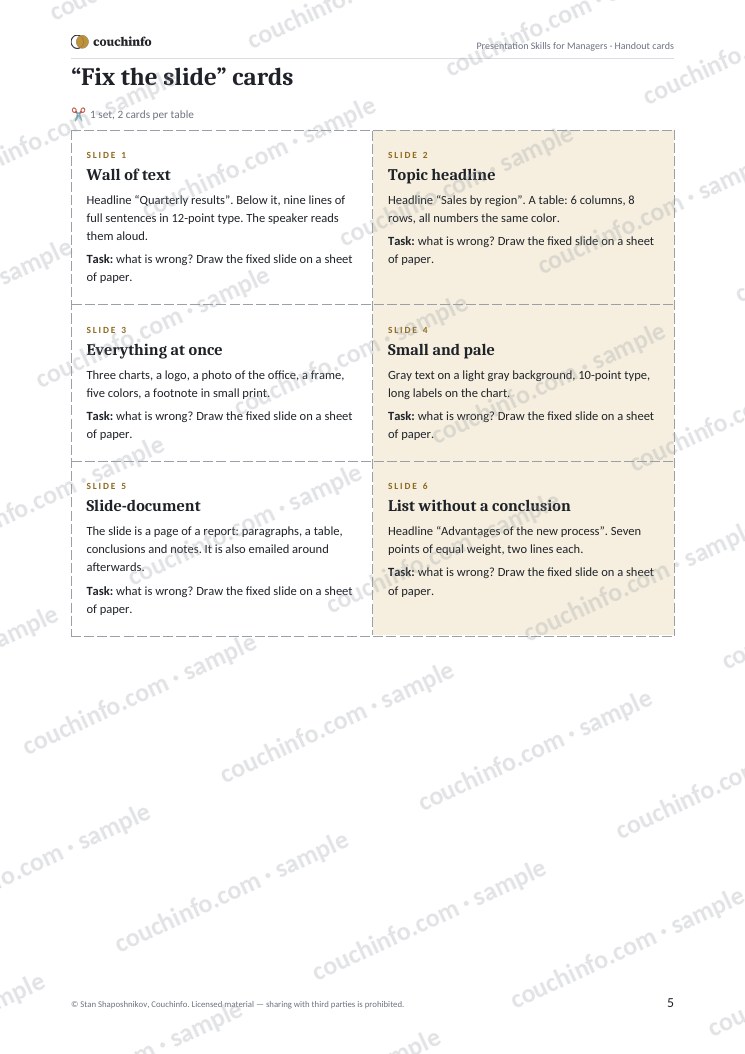
17 exercises with keys; 6 talk topics, "One number — one conclusion" and "Fix the slide" cards, 10 tough questions and situations, a "Slide from AI" card, checklists
Tests and forms
Pre-/post-test, answer key, feedback form
License
Terms of use

License. Run the training as many times as you like, edit the materials and add your own logo. You may not resell the files or share them with third parties. License terms
Exercises from this kit
Fix the Slide
Practice the six principles of a clear slide on other people's slides and your own.
Presentation Skills for ManagersOne Number, One Conclusion
Learn to turn data into a conclusion that is clear in three seconds.
Presentation Skills for ManagersTough Questions on Cards
Respond to tough questions and glitches in four steps without losing the thread of the talk.
Need it tailored to your company?
We will rewrite the cases around your situations, apply your brand style and prepare your trainers.
Other training kits
Leadership and Accountability
Language of accountability, RACI and the conversation with an employee
Coaching and Team Leadership
Coaching conversations, GROW and leading a team
Facilitation for Managers
Team meetings that end with a decision and an action plan
Conflict Resolution for Managers
Difficult conversations that make teams stronger
Negotiation and Influence for Managers
Reach agreement and persuade without pressure or manipulation

Performance Management with AI
Goals and OKR, metrics, one-to-ones and the manager's AI assistant

Emotional Intelligence for Leaders
Understand emotions, manage reactions and handle difficult conversations
AI and Automation Adoption: Leading Your Team Through Change
The change curve, resistance and an AI adoption plan
Motivation and Inspiration Tools for Leaders
DISC, the motivational conversation, inspiration and feedback
Managing Processes and Resources: Unconventional Solutions
Unconventional solutions, task setting, delegation and control

Managing Your Inner Resources: Energy, Motivation, Recovery
Energy, self-motivation, working with beliefs and recovery